
FOMC Statement: Fed Holds Steady on Rates
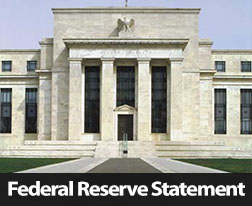
FOMC Statement Fed Holds Steady on RatesAccording to statement issued at the conclusion of today’s Federal Open Market Committee meeting, committee members decided against raising the target federal funds rate. Mixed economic conditions, slower economic growth in the 4th quarter and low inflation contributed to the decision against raising rates. The target federal funds rate was raised in December to a range of 0.25 to 1.59 percent after remaining at 0.00 to 0.25 percent for several years. While rising fed rates were expected to cause a hike in mortgage rates, mortgage rates fell after December’s rate hike.

Committee Cites Mixed Data in Decision

While labor conditions and housing markets continue to improve, FOMC members said that further improvement in labor markets and achieving the medium term goal of inflation influenced the committee’s decision not to raise rates. The Federal Reserve has a dual goal of achieving maximum employment and 2 percent inflation. While labor conditions continue to improve, the Committee wants to see further improvement. The inflation rate has stubbornly stayed below 2 percent and lower energy and non-energy import prices caused the inflation rate to fall further in recent weeks. The Fed also downgraded its reading of household spending and business investment growth from “strong” to “moderate.”

FOMC members consider global economic and financial conditions as well as trends and developing news affecting domestic economic and financial developments. Wednesday’s statement emphasized that constant monitoring and analysis of financial and economic readings are significant in monetary policy decisions. Analysts noted that recent economic developments including slowing economic growth in the US and China, along with resulting turbulence in financial markets likely contributed to the Fed’s decision not to raise the federal funds rate.

FOMC Says Policy Decisions to Remain “Accommodative”

Members of the FOMC do not expect marked economic improvement in the short term and said that they expect Fed monetary policy to remain accommodative “for some time.” This suggests that rapid rate hikes are not likely to occur in the near future; the Fed’s commitment to gradual rate increases is expected promote further improvements in labor markets and hold down borrowing rates for consumer credit and mortgages.

The Committee’s vote not to increase rates was unanimous. The next FOMC meeting is set for March 15 and 16. In the meantime, Fed Chair and FOMC Chair Janet Yellen is slated to testify before Congress about the economic outlook on February 10 and 11.

What’s Ahead For Mortgage Rates This Week – January 25, 2016

Whats Ahead For Mortgage Rates This Week January 25 2016Last week’s scheduled economic news included releases from the National Association of Home Builders, Housing Starts, and Existing Home Sales. Weekly reports on new jobless claims and mortgage rates were also released. 

The National Association of Realtors® reported that sales of previously owned homes rose to 5.46 million sales on an annual seasonally adjusted basis in December. This reading surpassed expectations of 5.21 million sales and November’s reading of 4.76 million sales. November’s low reading was in part affected by new mortgage rules, which delayed some closings into December. Economic factors pushing housing markets include low driven by falling fuel costs easing consumers’ budgets could provide confidence to move up to a larger home and for first time buyers to enter the market.

Existing Home Sales Up 7.6 Percent in December

There was a 3.9 month supply of pre-owned homes on the market in December; this was the lowest inventory since January 2005. High demand for homes and a slim supply of available homes continued to tighten housing markets. Growing demand for homes coupled with a shortage of homes for sale are driving up prices; the national average price of a pre-owned home rose 7.60 percent in December to $224,100. Rapidly rising home prices present an obstacle to first time buyers and as home prices rise, more buyers will face affordability concerns.

Housing Starts dipped in December to 1.15 million as compared to expectations of 1.23 million and November’s reading of 1.18 million housing starts annually. Builders constructed homes in 2015 at the highest rate since the recession. While December’s reading fell short of expectations, housing starts increased nearly 11 percent year-over-year. While builders cite obstacles such as shortages of land and labor, a growing pace of housing starts is seen as a partial solution to the shortage of available homes.

Building permits issued increased 12 percent in 2015; permits issued gauge future building activity and supply of available homes.

Mortgage Rates Fall for Third Consecutive Week

Average mortgage rates fell last week according to Freddie Mac. The average rate for a 30-year fixed rate mortgage dropped 11 basis points to 3.81 percent; the rate for a 15-year fixed rate mortgage fell by nine basis points to an average of 3.10 percent. The average rate for a 5/1 adjustable rate mortgage dropped 10 basis points to 2.91 percent. Discount points averaged 0.60, 0.50 and 0.40 percent respectively. Sean Becketti, chief economist for Freddie Mac, cited turbulence in the financial markets as a factor contributing to lower mortgage rates.

New jobless claims rose to a seven week high of 293,000 new claims as compared to expectations of 279,000 new claims and the prior week’s reading of 283,000 new claims. The four-week rolling average of new claims jumped by 6.500 new claims to an average of 285,000 claims. Lingering layoffs of temporary holiday workers were cited as contributing to higher first-time claims.

What’s Ahead

Next week’s scheduled events include data on new and pending home sales, the Case-Shiller home price indexes. The Fed will release its latest FOMC statement. Weekly reports on mortgage rates and new jobless claims will be released as usual. Reports on consumer confidence and sentiment will also be released.

What’s Ahead For Mortgage Rates This Week – January 18, 2016

Whats Ahead For Mortgage Rates This Week January 18 2016In addition to weekly reports on mortgage rates and new unemployment claims, last week’s economic news included the Fed’s Beige Book report, retail sales and consumer sentiment. January’s Empire State Index showed an unexpected dip and Consumer Sentiment increased for January.

Fed’s Beige Book Shows Diverse Economic Trends

According to the Federal Reserve’s Beige Book report for January, the central bank’s business contacts reported strength in housing, while agriculture, energy and manufacturing sectors were struggling. New York’s Empire State Manufacturing Index for January supported this trend with a sharp drop. New York manufacturing has hit its lowest level since the recession and has stayed in negative territory since March 2009. Two analysts said that the Fed’s recent rate hike and subsequent hikes could slow housing markets. Consumer lending rates, including mortgage rates, typically follow suit when the Fed increases its target federal funds rate. 

In other news, retail sales posted negative growth of -0.10 percent in December against an expected reading of -0.20 percent and November’s reading of +0.40 percent. December retail sales not including auto motive also posted a reading of -0.10 percent as compared to expectations of +0.20 percent and November’s reading of 0.30 percent.

Mortgage Rates Fall, New Unemployment Claims Rise

Last week’s average mortgage rates fell across the board according to Freddie Mac. The average rate for a 30-year fixed rate mortgage dropped by five basis points to 3.92 percent; the average rate for a 15-year mortgage rate also fell by five basis points to 3.19 percent. The average rate for a 5/1 adjustable rate mortgage was eight basis points lower at 3.01 percent. Average discount points were 0.60, 0.50 and 0.40 percent respectively.

New unemployment claims rose to 284,000 against expectations of 275,000 new claims and the prior week’s reading of 277,000 new claims. Analysts said that the jump in claims resulted from job losses related to temporary holiday positions, but noted that last year’s momentum of falling jobless claims has slowed.

Last week’s economic news ended on a positive note; consumer sentiment rose according to the University of Michigan. Lower prices were credited for the boost in consumer confidence in current economic conditions.

What’s Ahead

This week’s scheduled economic events include the National Association of Home Builders Housing Market Index, Housing Starts, Consumer Price Index and Core Consumer Price Index. No news will be released on Monday due to the Martin Luther King holiday.